
By Dr. Craig Mortensen, DC, IFMCP, QME | October 2026
Hormones! This is a complicated topic. Hormones run our body. They are involved in every bodily process, yet they are incredibly sensitive to outside factors. If you have hormonal symptoms and you've been bouncing between doctors with normal labs, you may want to consider a DUTCH test. It is much more than just a snapshot of a few hormones.
Let’s look at what exactly a DUTCH test is, what it measures, and where it falls short.
Why Standard Labs Miss the Whole Hormonal Picture
Here's a frustration I hear every week. A woman in her forties comes in with crushing fatigue, mood swings, hair thinning, and a sleep schedule that looks like a raccoon's. Her bloodwork? "Everything looks normal; it’s just your age.”
Well, you don’t have to feel terrible! As I said earlier, hormones are extremely sensitive to external factors, and they’re far more complicated than a single blood test can capture. That’s why the DUTCH test exists. A single blood draw is a photograph. It captures one instant of your hormones, and hormones aren’t a still life. They rise and fall across the day like a tide. Catch the wrong moment, and you've photographed the ocean at slack tide and announced there are no waves.
A DUTCH test doesn't just measure how much hormone you have circulating in your blood; it looks at how your body metabolizes those hormones.
What DUTCH Stands For
Dried Urine Test for Comprehensive Hormones. Precision Analytical developed it in 2012, and functional and integrative medicine has been using it ever since.
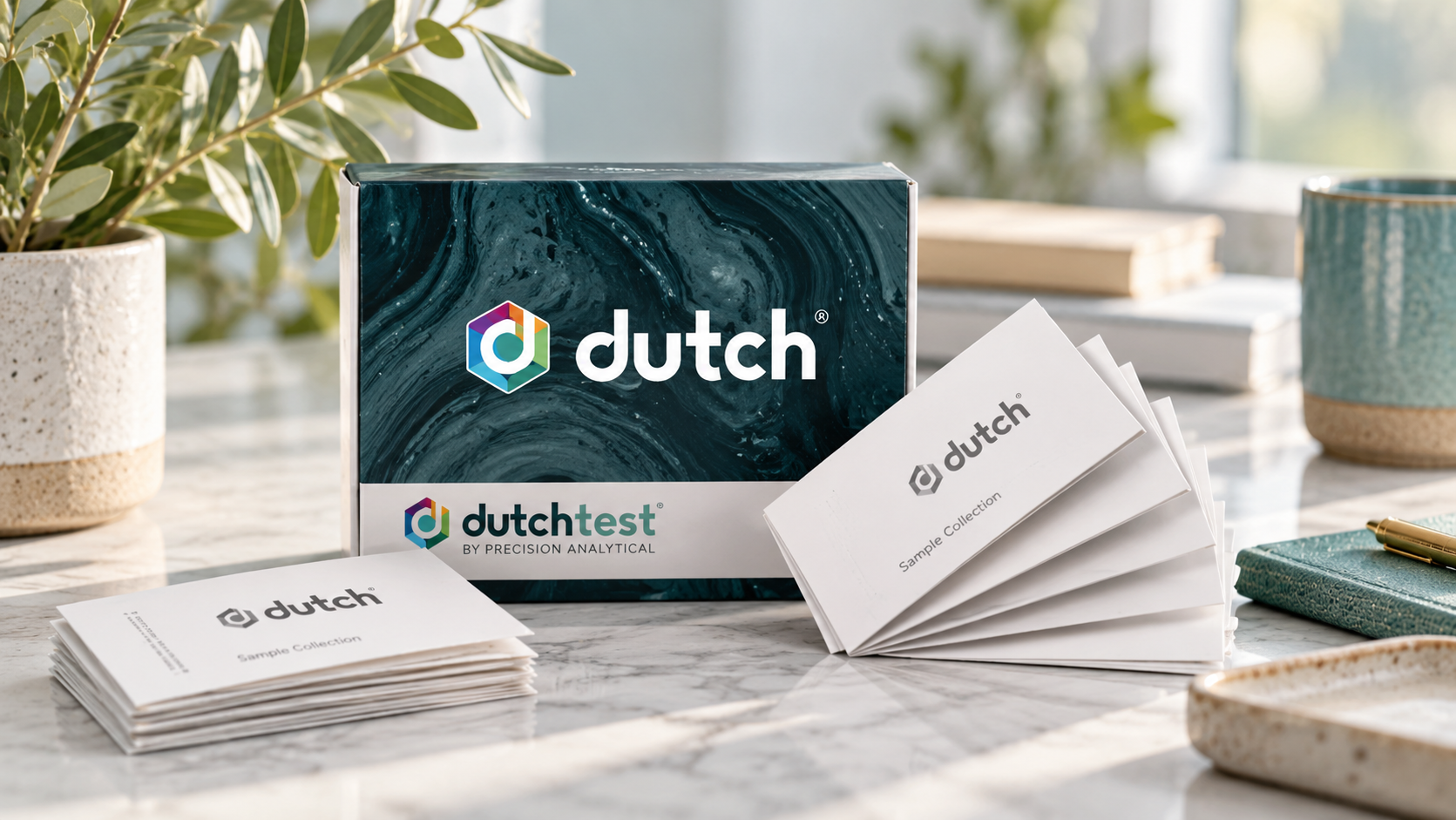
The idea is clever. Instead of a needle, you collect a few dried urine samples on filter paper at set points through the day, 4 or 5 samples in a 24-hour period, including one right after you wake. Then a lab runs them through mass spectrometry, the same gold-standard machine used in analytical chemistry. Which is important because:
A DUTCH test measures metabolites, not just hormones. Your body doesn't just make estrogen and cortisol; it breaks them down into byproducts, and how it does so matters. Think of it like a car: knowing you have a full tank tells you one thing. Knowing what the exhaust looks like tells you whether the engine is actually burning cleanly. DUTCH looks at the exhaust.
A DUTCH test maps a pattern across the day, not one frozen instant. For cortisol especially, that's the point: your rhythm through the day says more than a single number.
How the DUTCH Test Works
Once you order the DUTCH Test, your practitioner will have it shipped to your home. You will receive a kit that includes materials for urine collection and/or saliva collection (depending on the kit you are completing). Once complete, you put everything in the box and follow the instructions to mail it back. The test turnaround time is typically around 7 days. For women still cycling, your practitioner will tell you which day of your cycle to collect on.
What a DUTCH Test Can Measure
Depending on the panel, DUTCH reports on:
Sex hormones and their metabolites: estrogen, progesterone, testosterone, DHEA
Estrogen metabolism pathways: how you're processing estrogen
Cortisol pattern across the day: the stress rhythm, not just a number
Melatonin: the sleep hormone
Organic acids and nutritional markers: B12, B6, glutathione, and neurotransmitter metabolites, on the fuller panels
The main versions you'll hear named are DUTCH Complete (the flagship: sex hormones, cortisol pattern, metabolites, plus the organic-acid markers) and DUTCH Plus, which adds the Cortisol Awakening Response using a few saliva samples, a closer look at what your cortisol does in the first hour after you wake up. There's also DUTCH Cycle Mapping Plus, which tracks hormones across a full menstrual cycle rather than a single day, and DUTCH Cycle Mapping Plus + Complete.
How DUTCH Differs From Blood and Saliva Testing
Blood is the right tool when you need a precise snapshot of a specific hormone at a specific moment, such as measuring thyroid or estrogen. It's the standard for a reason.
Saliva is well-suited to free cortisol at set times.
DUTCH shines when the question is "how is my body producing, using, and clearing hormones across a whole day," the pattern and the breakdown, not the frozen instant.
None of these replaces the others. A good clinician picks the tool for the question.
Where Does a DUTCH Test Fall Short?
Here’s the honest part. A CLIA-certified lab runs the DUTCH test, and the lab work itself is solid. But it isn’t part of standard medical guidelines, most insurance plans won’t cover it, and the evidence behind it is still debated. Much of the research so far comes from smaller studies, many of them connected to the company itself. And we don’t yet have large trials proving that adjusting treatment based on these metabolite patterns leads to better results for patients. Critics also point out that DUTCH can’t replace a targeted blood test when you need to know exactly where a hormone stands at a given moment, and they’re right. That’s why, in functional medicine, we don’t skip the blood work in favor of a DUTCH. They answer different questions, and we use both.
Measuring something accurately and knowing exactly what to do with the number are two different questions. DUTCH measures well. The interpretation takes experience, judgment, and honesty, which is why I'd never hand a patient a report and a protocol and call it a day. It is a complicated test.
So my rule of thumb: foundational labs and lifestyle first, advanced testing second. DUTCH is a great tool in the right hands and the right context. It is not a magic crystal ball, and anyone selling it as one is selling you something. I never start with a DUTCH test with my patients. More about that in another post.
Is a DUTCH Test Worth it for You?
Maybe. If you've had normal bloodwork and nothing explains those symptoms, stubborn fatigue, cycle chaos, mood swings, sleep that won't cooperate, hormone issues in perimenopause, a DUTCH can surface patterns a standard panel misses and give a direction to work in. And guys, this isn’t just a women’s test. Low energy, low libido, poor sleep, or stress that’s taking a toll can all show up in a DUTCH.
If you're mostly feeling well and just curious? Start simpler. Sleep, diet, movement, stress, and basic labs will move more for you than an expensive urine panel.
And if you do get one, please, please have a qualified practitioner interpret it in the context of you. A report isn't a diagnosis. It's one page of a story that includes your history, your symptoms, and how you actually live.
The Bottom Line on DUTCH Specialty Testing
The DUTCH test answers an important question that standard labs often can’t: what are your hormones doing over time, and how is your body clearing them? Used well, it's a very useful window. Used as a sales pitch, it's an expensive one.
Bring your questions. Bring your old labs. We'll figure out together whether this tool fits your story, or whether something simpler does, like going back to basics.
If you’re ready to dig into your hormones, learn what to expect as a new patient, or call us at (877) 571-3801. Our team, including Jessica Cardona, works with women’s hormone health every day.
I'm Dr. Craig Mortensen.
Be healthy, be happy!
Written by Dr. Craig Mortensen, DC, IFMCP, QME, IFM-Certified Functional Medicine Physician and founder of Premier IFM in Placentia, CA, serving patients throughout Orange County and Southern California.