
Functional Medicine for
Hormone Imbalances
When Your Hormones Feel “Off,” It’s Often a Symptom — Not the Cause

Imagine waking up every morning feeling exhausted before your feet even hit the floor. Your mood swings like a pendulum, your clothes don’t fit the way they used to, and no matter how “healthy” you eat or how much you sleep, something still feels fundamentally wrong.
You’ve been told it’s “just stress,” “part of aging,” or “normal for your stage of life.” But deep down you know — this isn’t normal. Your hormones aren’t just “off”… they’re signaling that something deeper is out of balance.
At Premier Integrative Functional Medicine, we specialize in helping patients throughout Orange County and Southern California uncover the real reasons behind hormone imbalances. We don’t chase isolated symptoms with another pill. Instead, we listen to your unique story, run advanced testing, and create personalized plans that address root causes so you can finally feel energized, balanced, and like yourself again.
If you’re tired of feeling like a stranger in your own body, relief is closer than you think.
Ready to feel like YOU again?
The Problem with the Traditional Approach to Hormones
When most people visit a conventional doctor for hormone concerns, the process is often straightforward but limited: a single blood draw, a quick review of basic lab numbers, and a prescription for birth control, thyroid medication, antidepressants, or hormone replacement therapy (HRT).
While these interventions can sometimes provide short-term relief, they rarely ask the most important question: Why did your hormones become imbalanced in the first place?
Traditional medicine typically:
Looks only at isolated hormone levels (like a one-time TSH or estradiol) instead of how your body produces, uses, metabolizes, and clears those hormones.
Overlooks upstream contributors such as chronic stress, gut dysfunction, inflammation, environmental toxins, nutrient deficiencies, and blood-sugar instability.
Relies heavily on synthetic or suppressive treatments that can create dependency or new imbalances over time.
The outcome? Many patients feel marginally better for a few months, only to watch symptoms return — or new ones appear. At Premier Integrative Functional Medicine in Fullerton, we take a completely different approach. We treat the whole person and the root causes, helping your body regain its natural ability to regulate hormones sustainably.


The Facts – Hormone Imbalances Are More Common Than Most People Realize
Hormone issues affect millions of people, yet many go unrecognized or undertreated.
Some estimates suggest up to 80% of women experience some form of hormonal imbalance during their lifetime.
Thyroid disorders affect about 1 in 8 women, and women are 5–8 times more likely than men to develop them. Up to 60% of people with thyroid disease may not even know they have it.
PCOS (Polycystic Ovary Syndrome) impacts roughly 10–13% of women of reproductive age worldwide and is one of the leading causes of infertility and metabolic challenges. Up to 70% of cases may go undiagnosed.
Low testosterone (sometimes called andropause) affects a significant number of men, with levels typically declining about 1% per year starting in the 30s or 40s. - AKA Male Menopause
These numbers help explain why so many people feel “off” even when basic labs come back “normal.” The good news is that once root causes are properly identified and addressed, meaningful and lasting improvement is not only possible — it’s common.
Common Signs and Symptoms of Hormone Imbalances
Because hormones influence nearly every system in the body, symptoms can show up in many different ways. You don’t need to experience every symptom on this list — even a handful can indicate an underlying imbalance.
Energy & Metabolism
Persistent fatigue or afternoon energy crashes
Unexplained weight gain, especially around the midsection
Difficulty losing weight despite diet and exercise
Feeling cold all the time or having temperature intolerance
Mood & Mental Clarity
Mood swings, anxiety, irritability, or feelings of depression
Brain fog, poor concentration, or memory issues
Sleep disturbances — trouble falling asleep, staying asleep, or waking up feeling wired
Reproductive & Sexual Health
Low libido or discomfort during intimacy
Difficulty conceiving
Hot flashes or night sweats
Physical Appearance & Skin
Thinning hair, hair loss on the scalp, or unwanted facial/body hair
Persistent adult acne or cystic breakouts
Dry skin, brittle nails, or changes in skin texture
Other Common Clues
Digestive issues such as bloating, constipation, or irregular bowel movements
Frequent headaches or migraines
Intense sugar cravings or blood-sugar rollercoasters
If several of these resonate with you, your hormones may be the missing link. Many of our patients in Southern California come to us after years of feeling dismissed by conventional care — only to discover that targeted root-cause support changes everything.
Our Advanced Testing Approach – Going Far Beyond Standard Labs
At Premier Integrative Functional Medicine, we believe accurate answers require better data. Standard blood tests provide only a single snapshot in time and often miss subtle or dynamic imbalances. That’s why we use more comprehensive tools designed to reveal how your body is truly functioning.
One of the cornerstones of our hormone evaluation is the DUTCH Complete test (Dried Urine Test for Comprehensive Hormones). This at-home collection kit measures:
Sex hormones (estrogen, progesterone, testosterone) and their metabolites — showing not just levels, but how your body processes and clears them.
Adrenal hormones (cortisol and cortisone) with a full daily rhythm — revealing stress patterns, burnout, or abnormal spikes/dips that affect sleep, energy, and metabolism.
Organic acids and additional markers that provide insight into nutrient status, neurotransmitter balance, and detoxification capacity.
We also frequently run:
Comprehensive thyroid panels (including TSH, T4, free T4, T3, free T3, reverse T3, and thyroid antibodies) to assess true thyroid function rather than just screening.
Gut health testing to identify inflammation, dysbiosis, or leaky gut that can dramatically disrupt hormone metabolism.
Toxin and nutrient panels when environmental exposures or deficiencies are suspected.
These advanced tests allow us to create highly individualized plans instead of generic protocols. Patients often tell us the depth of information we uncover feels like finally getting the full picture after years of partial answers.


Why Choose Functional Medicine – And What It Can Do for Hormone Imbalances
Functional medicine at Premier Integrative Functional Medicine looks at the interconnected web of systems that influence hormone health: the gut microbiome, adrenal (stress) axis, liver detoxification pathways, insulin sensitivity, nutrient status, and environmental load.
Instead of masking symptoms, we support your body’s innate ability to self-regulate. A typical plan might include:
Personalized nutrition and meal strategies that stabilize blood sugar and reduce inflammation.
Targeted supplementation based on your specific test results (never a one-size-fits-all approach).
Stress-resilience practices, sleep optimization, and movement recommendations tailored to your energy and lifestyle.
Gentle detoxification support when needed.
Bioidentical hormones used judiciously — and only after foundational systems are strengthened.
Many of our patients notice improvements in energy, mood, and sleep within 4–8 weeks. Deeper shifts — such as more regular cycles, easier weight management, clearer skin, and restored libido — often emerge within 3–9 months. The goal is sustainable balance so you don’t have to rely on ongoing symptom management. Root cause really plays a huge role in how quickly you feel changes.
The Hormone–Gut–Stress Connection
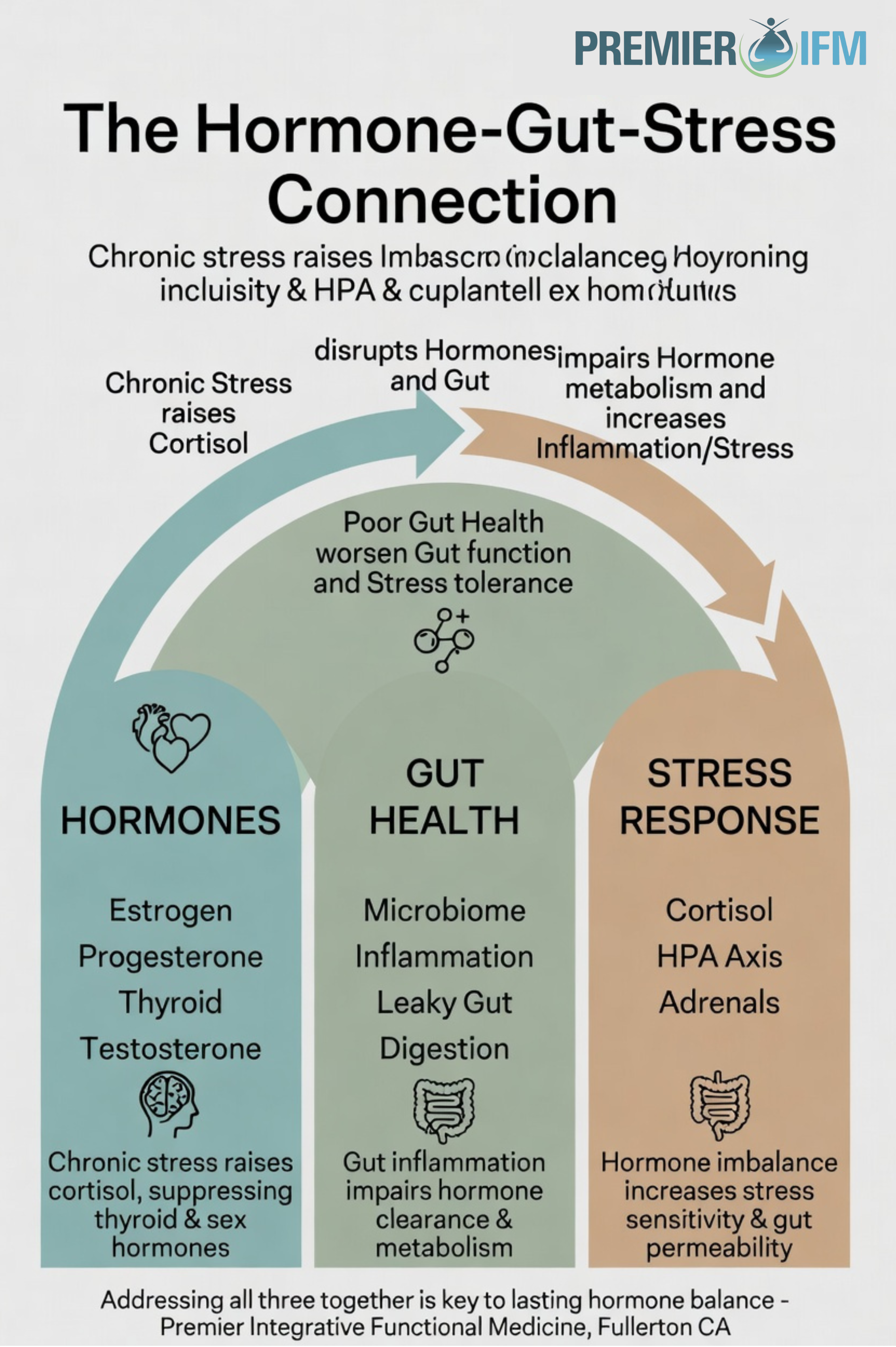
Hormones do not exist in isolation. Three major systems constantly interact: your hormones, your gut, and your stress response.
Chronic stress raises cortisol, which can suppress thyroid and sex hormone production while increasing inflammation. An inflamed or imbalanced gut (dysbiosis or leaky gut) impairs the metabolism and clearance of estrogen and other hormones, leading to further imbalance. Poor hormone balance, in turn, worsens stress tolerance and gut function — creating a vicious cycle.
At our Placentia clinic, we routinely address this triangle together. Healing the gut often improves hormone metabolism dramatically. Calming the stress response supports both gut repair and hormone production. This systems-based view is why our patients frequently experience broader improvements in digestion, mood, immunity, and energy — not just hormone-related symptoms.
Male Hormone Deficiency & Male Menopause (Andropause)
Many men silently struggle with hormone decline for years before seeking help. Society often teaches men to “suck it up,” “be tough,” and “walk it off,” which leads to delayed care or complete avoidance of the issue. As a result, men frequently wait until their symptoms become unbearable before addressing them.
At Premier Integrative Functional Medicine in Fullerton, we understand this pattern and create a comfortable, non-judgmental space for men to finally get the answers and solutions they deserve.
Low testosterone (also known as male menopause or andropause) affects a significant number of men. Research shows that testosterone deficiency can impact up to 60% of men over the age of 35, and the decline typically begins around age 30 with levels dropping roughly 1% per year.
It’s Not Just About “Normal” Lab Ranges
Here’s what most conventional doctors miss: The standard “normal” range for total testosterone is approximately 270 – 1070 ng/dL. If your level falls anywhere inside that broad range, you’re often told everything is fine.
But optimal testosterone for a healthy, vibrant man is very different.
A 22-year-old man with 950–1000 ng/dL usually feels strong, energetic, confident, and has a healthy sex drive.
The same man at age 38, now sitting at 320 ng/dL (still “normal”), often feels like less than one-third of who he used to be — exhausted, unmotivated, gaining belly fat, losing muscle, and struggling with libido and mood.
This is why so many men say: “My labs are normal… but I feel terrible.”


Common Signs and Symptoms of Male Hormone Deficiency
Men often notice these changes but may not connect them to declining testosterone:
Persistent fatigue and low energy
Depressed mood, irritability, or lack of motivation
Reduced sex drive (low libido)
Erectile dysfunction or difficulty maintaining erections
Decreased semen volume
Hair thinning or loss
Loss of muscle mass and strength
Increased body fat, especially around the abdomen
Decreased bone density
Mood swings or increased anxiety
If several of these sound familiar, even if your previous labs were labeled “normal,” you may be experiencing male hormone deficiency or andropause.
At Premier Integrative Functional Medicine, we don’t just look at whether you’re “normal.” We evaluate optimal ranges, free testosterone, hormone metabolites, and the underlying root causes — including stress, gut health, sleep, and nutrient status — to help you regain energy, strength, mental clarity, and vitality.

Female Hormone Imbalance & Deficiency
Female hormone imbalances are one of the most common issues we see at Premier Integrative Functional Medicine in Fullerton. It is not unusual for us to welcome 1-2 new female patients each week who are struggling with hormonal issues.
While hormonal changes are often associated with perimenopause and menopause, we are increasingly seeing moderate to severe hormone imbalances in much younger women — sometimes as early as their late 20s and early 30s. Environmental toxins, chronic stress, adrenal fatigue, thyroid dysfunction, autoimmune conditions, and poor gut health are all contributing to this earlier onset.
A woman’s hormonal system is incredibly complex and delicate. Unlike men, whose hormone balance is largely driven by testosterone, women have multiple hormones (estrogen, progesterone, testosterone, cortisol, thyroid hormones, and more) that constantly interact and influence one another. When one falls out of balance, it can trigger a cascade of symptoms.
At Premier Integrative Functional Medicine, we don’t simply treat the symptoms. We focus on identifying and correcting the root causes — whether they stem from inflammation, gut dysfunction, toxin exposure, stress, or nutrient deficiencies — so the body can restore natural hormone balance.
Common Signs and Symptoms of Female Hormone Imbalance
Women often experience some or many of the following symptoms:
Hot flashes and night sweats
Insomnia and sleep disturbances
Mood swings, irritability, anxiety, or depression
Persistent fatigue and low energy
Brain fog and difficulty concentrating
Weight gain, especially around the midsection
Vaginal dryness and painful intercourse
Low libido
Endometriosis or worsening PMS
Irregular or heavy periods
This is not an exhaustive list, but these are the symptoms we hear most frequently.
The good news is that with a root-cause functional medicine approach, lasting improvement is absolutely possible. By using advanced testing (such as the DUTCH Complete test) and addressing the underlying drivers, many women regain energy, stable mood, restful sleep, and a renewed sense of well-being.


FAQ - Common Questions About Functional Medicine for Hormone Imbalances
-
Endocrinologists and OB-GYNs excel at managing acute or structural hormone issues. We specialize in uncovering the underlying “why” when symptoms persist despite normal standard labs or conventional treatments.
-
Our primary goal is to help your body produce and regulate its own hormones again. Many patients are able to reduce or eliminate the need for supplemental hormones once root causes are addressed.
-
Many notice better sleep and energy within 4–6 weeks. Improvements in mood, cycles, weight, and overall well-being commonly appear by 3 months. Timelines vary based on how long the imbalance has existed and individual factors. Remember this is a process and although you start to feel better, long term goals and long term changes are a process that take longer.
-
Yes. Low testosterone, fatigue, brain fog, and age-related changes respond very well to our root-cause approach.
-
This is extremely common. We use optimal ranges, metabolite patterns, daily cortisol curves, and the full clinical picture — not just broad reference ranges.
-
We provide superbills for potential reimbursement. Labs sometimes are covered by insurance, it depends on the lab and your insurance coverage. We also offer transparent self-pay packages because we believe accessible, root-cause care should not be out of reach.