
Alpha vs. Gamma Vitamin E: Why the Type of Vitamin E You Take Matters
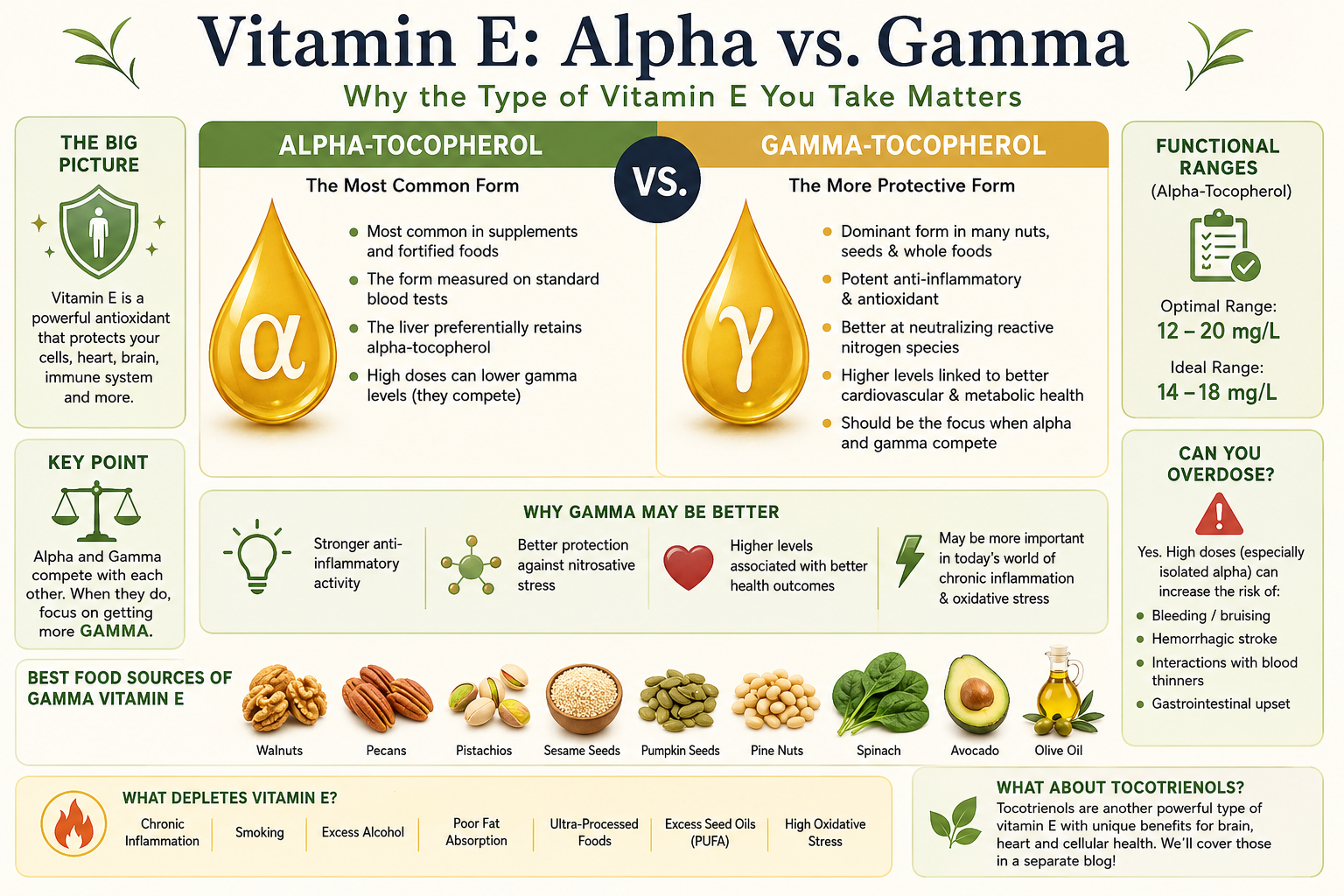
Alpha vs Gamma tocopherol (vitamin E)
Most people think vitamin E is a single nutrient.
It’s not.
Vitamin E is actually a family of compounds, and understanding the differences between them may completely change the way you look at supplementation, inflammation, heart health, and aging.
One of the biggest problems in modern nutrition is that most supplements and fortified foods focus almost entirely on alpha-tocopherol, while largely ignoring gamma-tocopherol—a form that many researchers and functional medicine practitioners now believe may be more important for long-term health.
In this article, we’ll break down:
The different forms of vitamin E
The difference between alpha and gamma vitamin E
Why gamma may actually be the superior form
Why too much alpha can create imbalance
Best testing methods
Food sources
Factors that deplete vitamin E
Whether you can overdose on vitamin E
We’ll briefly touch on tocotrienols near the end, but those deserve an entire article of their own.
What Is Vitamin E?
Vitamin E is a fat-soluble antioxidant that protects the body from oxidative stress and free radical damage.
Its major roles include:
Protecting cell membranes
Supporting brain and nerve health
Reducing inflammation
Protecting cardiovascular tissue
Supporting immune function
Helping maintain healthy skin
Preventing oxidation of fats and cholesterol
Because it is fat-soluble, vitamin E is absorbed with dietary fats and stored in body tissues.
The Different Types of Vitamin E
Vitamin E exists in multiple forms, but for this discussion we are going to focus primarily on the two most important tocopherols:
Alpha-tocopherol
Gamma-tocopherol
These are naturally occurring forms of vitamin E found in food.
Most conventional supplements focus heavily on alpha-tocopherol because it was historically considered the “main” vitamin E. But research over the last several decades has shown that gamma-tocopherol may provide unique and potentially more powerful benefits.
Alpha-Tocopherol: The Most Common Form
Alpha-tocopherol is the form most commonly:
Added to supplements
Added to fortified foods
Measured on blood tests
Studied in older research
The liver preferentially retains alpha-tocopherol using a transport protein called:
Alpha-tocopherol transfer protein (α-TTP)
This causes alpha-tocopherol to dominate blood levels.
Because of this, many people assume higher alpha levels automatically mean optimal vitamin E status.
Unfortunately, that is not always true.
Gamma-Tocopherol: The More Protective Form?
Gamma-tocopherol is the dominant form of vitamin E found in many natural foods, including:
Nuts
Seeds
Walnuts
Pecans
Sesame
Pistachios
Unlike alpha-tocopherol, gamma-tocopherol appears especially effective at neutralizing:
Reactive nitrogen species
Peroxynitrite
Inflammatory oxidative compounds
This is important because chronic inflammation is one of the major drivers behind:
Heart disease
Neurodegeneration
Insulin resistance
Accelerated aging
Many functional medicine practitioners now believe gamma-tocopherol may actually be the more protective and clinically useful form of vitamin E.
Why Gamma Vitamin E May Be Better Than Alpha
1. Better Anti-Inflammatory Activity
Gamma-tocopherol appears more effective at trapping certain inflammatory free radicals that alpha-tocopherol does not neutralize as well.
This may make gamma more important for:
Chronic inflammation
Cardiovascular protection
Metabolic health
Neuroinflammation
2. Better Protection Against Nitrosative Stress
Modern lifestyles create enormous oxidative and nitrosative stress through:
Pollution
Processed foods
Smoking
Chronic infections
Inflammation
High blood sugar
Gamma-tocopherol seems uniquely suited to combat this type of damage.
3. Higher Gamma Levels Are Often Associated With Better Outcomes
Several studies have associated higher gamma-tocopherol levels with:
Reduced inflammatory markers
Better cardiovascular health
Lower oxidative stress burden
Meanwhile, isolated high-dose alpha-tocopherol supplementation has produced mixed or disappointing results in many clinical trials.
The Problem With High-Dose Alpha Vitamin E
This is where things get especially important.
Alpha and gamma tocopherol can compete with one another.
When people take high doses of isolated alpha-tocopherol supplements, gamma-tocopherol levels often decrease.
In other words:
Excess alpha may suppress gamma.
This is one reason many functional medicine practitioners avoid high-dose isolated alpha-tocopherol products.
Instead, the focus is shifting toward:
Mixed tocopherols
or evenGamma-dominant vitamin E formulas
Why We Should Focus More on Gamma
Most people already get plenty of alpha-tocopherol from:
Fortified foods
Multivitamins
Supplements
But many people do not get enough gamma-tocopherol-rich foods.
At the same time:
Chronic inflammation is rising
Oxidative stress is increasing
Processed diets are more common than ever
This makes gamma-tocopherol increasingly important.
From a functional medicine perspective, the goal is not simply:
“More vitamin E”
The goal is:
Better balance between vitamin E forms
Better antioxidant protection
Reduced inflammatory stress
And that likely means prioritizing gamma rather than overloading alpha.
Functional Medicine Optimal Vitamin E Ranges
Most lab testing only measures:
Serum alpha-tocopherol
Conventional ranges are often broad and designed mainly to identify severe deficiency.
Functional medicine aims for:
Better antioxidant protection
Reduced inflammation
Improved neurological and cardiovascular support
Functional Medicine Serum Alpha-Tocopherol Range
A commonly targeted optimal range is:
12–20 mg/L
Many practitioners prefer:
14–18 mg/L
However, interpretation should also consider:
Lipid levels
Inflammatory burden
Oxidative stress
Dietary intake
A normal alpha-tocopherol level does not necessarily mean gamma levels are optimal.
What Is the Best Way to Test Vitamin E?
1. Serum Alpha-Tocopherol
This is the standard laboratory test.
It measures circulating alpha-tocopherol levels and can help identify:
Deficiency
Malabsorption
Excess supplementation
But it has limitations because it does not fully assess:
Gamma-tocopherol status
Tissue antioxidant balance
Functional oxidative stress
2. Advanced Tocopherol Testing
Some specialty laboratories can evaluate:
Alpha-tocopherol
Gamma-tocopherol
Oxidative stress markers
This provides a much more complete picture.
3. Oxidative Stress Testing
Functional medicine practitioners may also evaluate:
Lipid peroxidation
Glutathione status
Inflammatory markers
This helps determine whether antioxidant demand is elevated.
Can You Overdose on Vitamin E?
Yes.
Vitamin E is fat-soluble, meaning excess amounts can accumulate in the body.
The biggest concern is usually:
High-dose alpha-tocopherol supplementation
Especially at doses above:
400–800 IU daily long term
Potential risks include:
Increased bleeding tendency
Easy bruising
Hemorrhagic stroke risk
Interaction with blood thinners
People taking:
Warfarin
Aspirin
Clopidogrel
Other anticoagulants
should be cautious with high-dose vitamin E supplements.
Signs of Too Much Vitamin E
Possible symptoms include:
Easy bruising
Nosebleeds
Headaches
Fatigue
Blurred vision
Gastrointestinal upset
More is not always better—especially when using isolated alpha-tocopherol.
Best Food Sources of Gamma Vitamin E
If the goal is to improve gamma-tocopherol intake naturally, focus on:
Nuts
Seeds
Whole foods
Top Gamma-Tocopherol Foods
Walnuts
Pecans
Pistachios
Sesame seeds
Pumpkin seeds
Pine nuts
Additional Sources
Avocados
Spinach
Olive oil
Legumes
These foods provide a broader antioxidant profile than isolated supplements.
What Depletes Vitamin E?
Many modern lifestyle factors rapidly increase antioxidant demand.
1. Chronic Inflammation
Inflammation consumes antioxidants quickly.
2. Smoking
Smoking dramatically increases oxidative stress.
3. Ultra-Processed Foods
Processed foods increase free radical burden while reducing nutrient density.
4. Excess Seed Oil Consumption
Large amounts of unstable processed oils may increase the need for vitamin E because vitamin E helps protect fats from oxidation.
5. Poor Fat Absorption
Vitamin E requires fat absorption.
Common causes include:
Gallbladder dysfunction
Celiac disease
Crohn’s disease
Pancreatic insufficiency
6. Alcohol
Alcohol increases oxidative stress and impairs nutrient handling.
What About Tocotrienols?
There is another major category of vitamin E compounds called:
Tocotrienols
These may have even more powerful effects on:
Brain health
Healthy aging
Cholesterol metabolism
Cellular protection
Tocotrienols are becoming one of the most exciting areas of vitamin E research.
But they deserve a full discussion on their own—which we’ll cover in a separate article.
Functional Medicine Takeaway
Vitamin E is far more complex than most people realize.
The biggest mistake in modern supplementation has been assuming that:
Alpha-tocopherol equals vitamin E.
It doesn’t.
Gamma-tocopherol may actually provide more important anti-inflammatory and antioxidant protection, especially in today’s high-stress, high-inflammation world.
Even more importantly:
High doses of alpha-tocopherol may suppress gamma-tocopherol levels.
That means taking large amounts of isolated alpha vitamin E could unintentionally create imbalance rather than improve health.
From a functional medicine perspective, the goal should be:
Better balance
More whole-food antioxidant support
Reduced oxidative stress
Greater focus on gamma-rich foods and mixed tocopherols
The future of vitamin E research is likely moving away from isolated alpha supplementation and toward a broader understanding of how these vitamin E compounds work together to protect the body.