
What if Getting Sick as a Kid Made You Safer from Cancer?
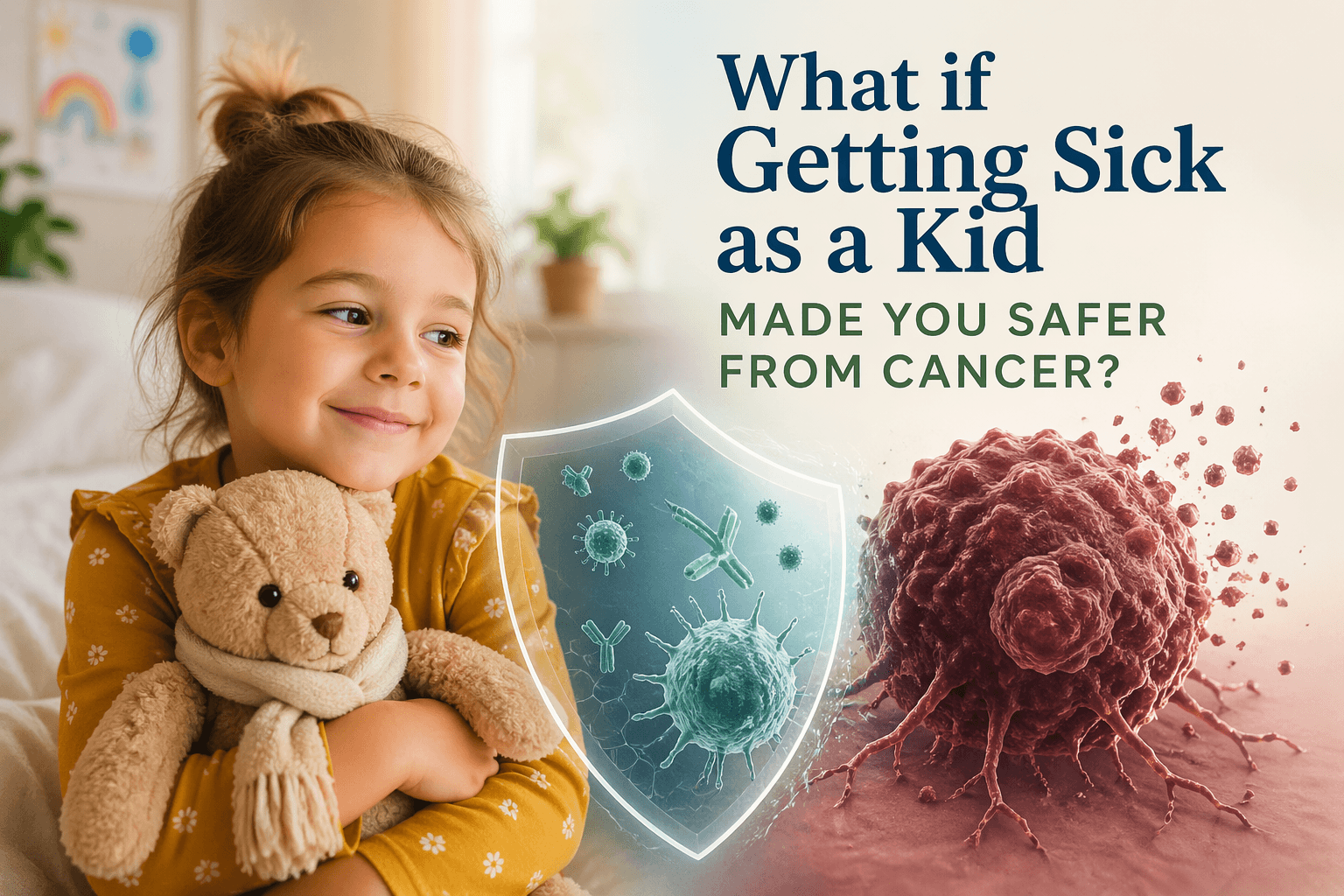
Emerging research suggests that some of the miserable illnesses of childhood — chickenpox, measles, mumps — may quietly train the immune system to fight cancer for decades to come.
Nobody looks back fondly on a week of chickenpox. The fever, the itching, the calamine lotion — it was a rite of passage that most of us were glad to leave behind. But a growing body of scientific research is asking an unexpected question: what if those miserable childhood illnesses were doing something quietly remarkable? What if they were teaching your immune system to spot and destroy cancer cells — a lesson that could last a lifetime?
The idea might sound far-fetched, but it has real scientific weight behind it. Researchers have found compelling associations between common childhood infections and lower rates of certain cancers in adulthood. It's a field that's reshaping how immunologists think about early life, disease, and the long-term logic of the immune system.
"Chronic infections are often tumorigenic. Acute infections, by contrast, appear to be antagonistic to cancer — a paradox that science is only beginning to unravel.”
The immune system goes to school
When a child gets a viral infection, the immune system doesn't just fight it off and forget it. It builds a lasting record — a molecular memory of the encounter. Specialized cells called memory T cells remain in the body for decades, primed to respond to anything that resembles the original invader.
The key insight from researchers is that this training has spillover effects. An immune system that has learned to fight a virus becomes generally more alert, more capable of recognizing and eliminating aberrant cells — including the kind that become tumors. Early life infections, in essence, put the immune system through a rigorous education that vaccines alone may not fully replicate.
The findings, disease by disease
CHICKENPOX → BRAIN CANCER
21% - lower risk of glioma — one of the most aggressive brain cancers — found in a landmark 9,000-person international study.
MEASLES → LYMPHOMA
68% - potential reduction in Hodgkin's lymphoma risk reported in research on febrile childhood infections.
FEBRILE ILLNESS → MULTIPLE CANCERS
+ Higher total number of childhood febrile illnesses correlated with lower rates of melanoma, ovarian cancer, and more.
The most rigorously studied link is between chickenpox and glioma — a type of brain tumor that accounts for about 80% of all malignant brain cancers. The Glioma International Case-Control Study, drawing on data from over 4,500 cases across five countries, found that a history of chickenpox was associated with a 21% lower glioma risk. The effect was strongest for the most aggressive, high-grade tumors, and particularly pronounced in patients who developed glioma before age 40.
Notably, the varicella-zoster virus (VZV) that causes chickenpox is neurotropic — meaning it specifically targets nervous tissue. After infection, it takes up long-term residence in nerve cells throughout the body. Researchers believe this prolonged immune engagement may create a heightened state of surveillance in neural tissue that makes it harder for tumors to take hold.
The leukemia puzzle
A separate line of evidence concerns childhood leukemia, specifically acute lymphoblastic leukemia (ALL), the most common childhood cancer. Here, the story is turned on its head: it is the absence of early infection that appears to raise risk. Children who attended daycare early in life — and thus were exposed to more infections at a younger age — show lower rates of ALL than those raised in more protected environments.
This fits with what some immunologists call the "delayed infection" hypothesis: an immune system that doesn't encounter pathogens early may overreact to its first exposures, and this dysregulation may be one pathway toward certain leukemias.
"Reduced exposure to infection in the first months of life appears to increase the risk of developing acute lymphoblastic leukemia. The immune system, it turns out, needs practice."
What this means — and what it doesn't
IMPORTANT CONTEXT
These are observational studies. Association is not the same as causation, and the effect sizes, while notable, require further confirmation.
None of this research suggests that children who don’t contract these diseases will develop cancer. This is still an area that requires further study and understanding. Vaccinations should be considered thoughtfully, taking into account both the risks of the diseases and each individual’s unique circumstances.
An open and important question is whether the modern chickenpox vaccine confers similar immunological benefits as the wild-type infection — researchers are actively investigating this.
People who get cancer may simply have had subtly weaker immune systems from birth — meaning they were always less likely to get chickenpox, not that chickenpox prevented their cancer.
The future: harnessing the lesson without the illness
The most exciting downstream implication of this research isn't a call to let your kids get sick — it's a blueprint for better cancer treatments. If childhood viral infections train the immune system to recognize and eliminate tumor cells, scientists want to understand exactly how, and then replicate that effect therapeutically.
Oncolytic virus therapy — engineering viruses to selectively infect and destroy cancer cells — is one active area. Other researchers are designing treatments that mimic the internal immune signaling of a viral infection within tumors, activating pathways that natural childhood illness would have primed. These approaches promise more targeted cancer treatment with fewer side effects than chemotherapy.
The emerging picture is a humbling one for medicine. The immune system, shaped by millions of years of evolution to contend with pathogens, may have developed its capacity to fight cancer as a side effect of fighting infection. Those miserable weeks of itching and fever were, in some small way, an investment — one the body may have been quietly drawing on ever since.
**This article is based on published peer-reviewed research, including the Glioma International Case-Control Study (GICC) and related work on febrile childhood infections and cancer risk. It is intended for general information only and should not be taken as medical advice.
Sources:
Glioma International Case-Control Study (GICC) — Amirian et al. (2016). "History of chickenpox in glioma risk: a report from the glioma international case–control study (GICC)." Cancer Medicine. https://pmc.ncbi.nlm.nih.gov/articles/PMC4924393/
Febrile infectious childhood diseases and cancer risk — A study published in Cancer Epidemiology, Biomarkers & Prevention examining the association between febrile childhood illnesses (measles, mumps, rubella, pertussis, scarlet fever, chickenpox) and reduced cancer risk across multiple cancer types.
Acute vs. chronic infections and cancer — Research summarized in: "Acute infections as a means of cancer prevention: Opposing effects to chronic infections," which found febrile childhood diseases associated with reduced risks of melanoma, ovarian cancer, and multiple cancers combined.
Daycare attendance and childhood leukemia (ALL) — Multiple case-control studies from the UK finding that early-life infection exposure (via daycare attendance, birth order) is associated with reduced risk of acute lymphoblastic leukemia. Referenced in: Early life exposure to infections and risk of childhood acute lymphoblastic leukemia.
CDC Cancer Prevention Across the Lifespan — "Opportunities During Early Life for Cancer Prevention," PMC. https://pmc.ncbi.nlm.nih.gov/articles/PMC5890502/
WHO Childhood Cancer Fact Sheet — World Health Organization. https://www.who.int/news-room/fact-sheets/detail/cancer-in-children